Showing posts with label curriculum. Show all posts
Showing posts with label curriculum. Show all posts
Wednesday, August 22, 2012
One page binyanim reference in color
I have been working on creating a visual reference for binyanim for the last few years. I was finally able to get it all into one page
Binyanim Letter One Page Color

Beginning of the year - binders
School is starting in less than two weeks. When I began teaching third grade two years ago, I envisioned backpacks stuffed with crumbled up paper and homework never done. I found a third grade teacher who explained how to use a binder to teach organization and help students gain independence during homework. It has worked for the last two years, and I am excited to use the system again.
Here is a write up I did the other year.
****************
Goals:
1. Students will gain organizational skills
2. Students will be empowered to complete homework independently
3. Students will complete homework independently
Materials needed:
1. Binder
2. Sheet Protectors
3. Dividers - The teacher should provide these with the appropriate labels already filled out. Every student's red divider is chumash, yellow is dinim, so you can teach the students how to add to their binder and use it with minimal instruction
4. Yoman
Instructions:
Have each student bring a 1 1/2 inch binder and dividers. Put in the yoman, sheet protectors, dividers and folder at the beginning of the school year. Teach the students how to add papers to the proper section. Send papers home to the parents in the folder in the binder. Leave 5 -10 minutes each day to add assignments to the binder
Helpful Tips:
1. During class, have the students use their reference guides to answer their questions rather than asking another student or a teacher. Example:Student "What does שמע mean" Teacher: "where can you look that up?" This will help them do their homework without needing parents help.
2. I have a store and a token economy for an incentive - I give $1 for the binder being organized at the end of the day and the homework recorded legibly and in the proper place and $1 the next day for the homework being handed in in the right place, yoman signed and the folder emptied.
Letter to parents
Here is a write up I did the other year.
****************
Goals:
1. Students will gain organizational skills
2. Students will be empowered to complete homework independently
3. Students will complete homework independently
Materials needed:
1. Binder
2. Sheet Protectors
3. Dividers - The teacher should provide these with the appropriate labels already filled out. Every student's red divider is chumash, yellow is dinim, so you can teach the students how to add to their binder and use it with minimal instruction
4. Yoman
Instructions:
Have each student bring a 1 1/2 inch binder and dividers. Put in the yoman, sheet protectors, dividers and folder at the beginning of the school year. Teach the students how to add papers to the proper section. Send papers home to the parents in the folder in the binder. Leave 5 -10 minutes each day to add assignments to the binder
Helpful Tips:
1. During class, have the students use their reference guides to answer their questions rather than asking another student or a teacher. Example:Student "What does שמע mean" Teacher: "where can you look that up?" This will help them do their homework without needing parents help.
2. I have a store and a token economy for an incentive - I give $1 for the binder being organized at the end of the day and the homework recorded legibly and in the proper place and $1 the next day for the homework being handed in in the right place, yoman signed and the folder emptied.
Letter to parents
Homework Binders
The Homework Binder is a
three ring binder that students will use every day to develop their
organizational skills. It contains dividers, folders, and sheet protectors.
Hopefully this binder will eliminate lost homework and disorganized backpacks.
Inside the Homework Binder
you will find:
Pencil Case:
This pencil case will be used to hold flash cards for current units. It should
not be used for regular school supplies.
Sheet Protectors: These
are used to help protect important classroom/school information & homework
helpers such as שרשים list, prefix
suffix list, בנינים charts, etc.
Yoman - homework book - with all assignments written
Judaic Homework sheet – The nightly homework assignment
חומש section: Linear translation for the current פרק as
well as any other handouts that may be necessary to complete the homework and study
for quizzes.
עברית section – current vocabulary words and grammar rules
General Studies
sections - for general studies homework and
all materials necessary to complete the homework.
Folder: Safely transports all paperwork to
and from school including graded work, newsletters, etc. Please empty on a regular basis
The binder must be brought
home every night and returned to school every day.
Homework
There will be homework most nights of the year. Homework
is important as it helps to practice and reinforce what is taught in class. It helps
prepare students for success.
·
The homework will be written in the
Yoman planner.
·
Some homework will be assigned at
the beginning of the week and due on Friday.
·
Any homework sheets will be found in
the Homework Binders.
·
Students should be able to
do most assignments on their own using the reference guides in the binder. If your child is not able to regularly finish
an assignment, please send a note or comment on the Yoman.
Sheet Protectors
The 2012-2013 sheet protectors have been prepared and contain
- Daily School Schedule
- Classmate List
- One page School Calendar
- A page with the whole hebrew alphabet including the block, script, and rashi fonts
- The cantillation marks (trop) that are used to divide pesukim http://www.scribd.com/doc/103654342
- A one page color-coded chart to conjugate hebrew verbs http://www.scribd.com/doc/103654348
- Reference page with all hebrew prefixes and suffixes
- vocabulary list of all verbs found in parshas Chayei Sarah
- A vocabulary list of all nouns found in Chayei Sarah.
This system works beautifully and can be shared by both the secular and Judaic faculty.
Monday, July 9, 2012
Teaching Rashi the fun way
Learning to read Rashi script was a highlight for many of my students this year. We took a full body approach to learning the new font. While moving, jumping and acting, my students learned their letters with a lot of joy.
Here is the teacher's workbook. It has some tips about how to make the more confusing letters become very recognizable. The best idea was the rashi letter simon says. Read on to find out more.
Rashi Workbook Teacher Edition 2012
Here is the student workbook Rashi Workbook 2012 Happy Learning
Here is the teacher's workbook. It has some tips about how to make the more confusing letters become very recognizable. The best idea was the rashi letter simon says. Read on to find out more.
Rashi Workbook Teacher Edition 2012
Here is the student workbook Rashi Workbook 2012 Happy Learning
Sunday, June 24, 2012
Hebrew resources
I was searching for some hebrew handwriting practice and came
across some great hebrew language resources from the place that is most logical
- Israel!
Summer work - http://kaye7.school.org.il/seasons_summer.htm#c2
http://kaye7.school.org.il/reading.htm -
links to Israeli websites that have kriyah resources
http://kaye7.school.org.il/eng/welcome.htm -
Resources for Israeli teachers for reading, chumash, etc.
http://www.kaleykaluli.com/index.php?option=com_content&view=article&catid=21&id=34&Itemid=11 -
stories for each new vowel and letter. printable
http://myfamilythoughts.wordpress.com/activitypages/ - Lesson plans – Look
for the handwriting sheets in particular
Saturday, June 9, 2012
June 8, 2011 recap
Today was one of those days that teachers dream about. A chance to see all my efforts over the year come full circle.
Here is how it happened.
We only had three pesukim left to learn in Parshas Vayeitzei. I had the class read the pasukim aloud without teaching them at all. Of course, as we were reading about Yaakov meeting up with the melachim, the class exploded with questions. Was Yaakov in Eretz Yisrael? How could the melachim of Eretz Yisrael come to greet him as Rashi says? Which malachim did he send to Har Seir? Surely not the melachim of Eretz Yisrael. In the beginning of Vayeitzei, he saw the melachim in a dream. Was this in a dream? The class started flipping forward to Vayishlach to discover more information about the melachim and their journey.
Finally, we finished the parsha with fifteen minutes to spare before recess. I was in a quandary. The day before, I had quizzed the class on the 30 shorashim in the perek, and they had done review work. I figured we could squeeze in the exciting parsha of behaalosecha in the extra time. Unfortunately, my parsha worksheets were in the office.
When I told the class my plan they asked if they could learn the next parsha while I was out of the room. I agreed if they kept the noise to a dull roar. I left and got sidetracked at the copier for a few minutes. When I returned, the students were sitting at the table and at their desks with chavrusas. They excitedly shouted "We finished to Pasuk יא - the eleventh verse!" I asked what that meant. They informed me that they had read and translated seven pasukim and were now asking questions about those pasukim.
Their eyes shone. They love to learn and know how to learn.
What nachas!
One of my theories of education is that students need to do the real thing. They don't have Chumash class. They learn Chumash - just like their fathers and mothers do. As a teacher, my job is to provide them with supports so they can act like the adults.
A perfect model for this method of education is training wheels on a bicycle. With training wheels, a child learns to ride his bike and the feel of bike riding. Then the training wheels come off, and the parent holds on to the back, providing less support, but still helping the child learn how to ride. Finally, the parent lets go. The child begins to peddle on his own. He may fall a few times, he may wobble at first, but very quickly he rides off on his own. His legs are strong enough, and his sense of balance has been developed so he no longer needs his parents to help him at all. And then a wonderful thing happens, the child begins to bike ride with the parents and they explore new paths together.
The same thing happens in school. My students know what it means to learn Torah. They see their parents do it, they see older students do it and they want to do it too. Nebach, they don't have the vocabulary or the maturity to learn as their parents do. So like the training wheels, they learn with a little help keeping them upright and moving forward. At first, they got a lot of help with vocabulary and reading. Later, in the year, once they had mastered the basic vocabulary, they only need help with the hard words. Then, the training wheels can come off so they can learn on their own. The final stage is when parent and child, teacher and student begin to learn together as partners in discovering the Torah. The progression must be gradual and deliberate to ensure that the child will get stronger and stronger until they are ready to be independent.
Today, I saw my theory vindicated. These kids are learning like real masmidim acting like they are sitting in a beis Medrash. They approach learning Torah with a sense of ownership and pride.
Teaching like this requires a change of mindset. A teacher can view himself like he is pulling a horse to water, as if he is doing all the hard work in the relationship. But with this attitude, when he is not around, his students won't want to learn. He can view himself like the driver of a car, who determines the roads yet to be travelled. But again, no student wants to go down a path that is determined by others.
Or, a teacher can view himself like he is that parent, holding on to the back of a bicycle without training wheels. His most fervent hope is that the child will pedal off, leaving the parent waving as he watches his child disappear around the corner with new-found independence. When a teacher teaches with this mindset, the child senses that he is the master of his learning. The child will take ownership for his learning as he is able to set his own course in life and blaze new trails.
Wednesday, April 25, 2012
Make your own Picture Dictionary: online resources working together
Language is learned visually. A mother says "shoe" to a baby as she dresses him. She points to her nose and names it.


Select all text (Ctrl-A)
Select the translated hebrew text and paste it in a new word document

You will need to edit the text to make sure that all the words were translated correctly.
Select approximately 10 lines from the hebrew document.
Select All - Ctrl-A

Select the two columns of text and copy
Click on the table with the english words
On the Layout Tab, select Properties

Change the table to right-to-left

Insert two columns to the left of the pictures

You can now use your new dictionary.
I try to provide as many visual cues for all my hebrew vocabulary lists. It takes me so much time to find the right Here is a great resource for this which requires a number of extra steps but will save you so much time having to find all the pictures yourself
Word lists
Enchanted Learning - An English Picture Dictionary
Choose a topic -
Select all the pictures on the web page & Copy (Ctrl-C)

Make a usable format for the pictures
Open a New Microsoft Word Document and Paste
Select all text (Ctrl-A)
Remove all hyperlinks (Ctrl-Shift-F9)
Convert table to text (paragraphs)

Prepare text to be converted into a new table:
Replace line with tabs Find: ^l Replace: ^t
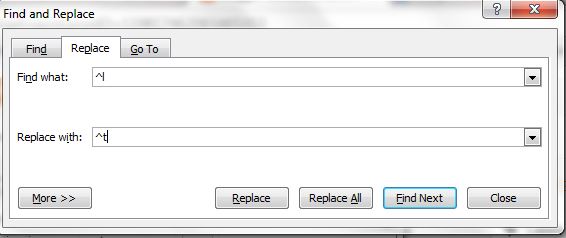
Replace line with tabs Find: ^l Replace: ^t

Select all text (Ctrl-A)
Convert text to table
Translating text into hebrew

Select the translated hebrew text and paste it in a new word document

You will need to edit the text to make sure that all the words were translated correctly.
Prepare the hebrew text to be merged with the pictures
: Find: ^l^l Replace with ^p
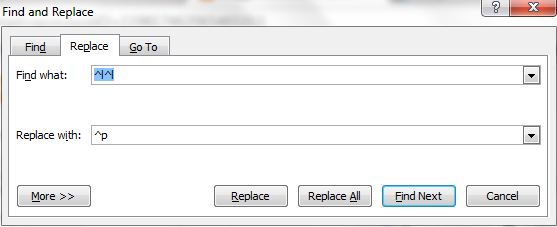

Find: ^p^l Replace with ^p


Find ^l Replace with " * "


Put in Nekudos

Select approximately 10 lines from the hebrew document.
Paste into the area on the right.
If there is a word that has the wrong nekudos, click on the word. Additional options to choose will appear.
Click נקד הכול.
Copy all the Text with nekudos
Paste it back into the word document and select another 10 lines of text
Keep adding nekudos until you have completed the whole document.
Get the hebrew text ready to be combine with English
Select All - Ctrl-A
Convert Text to Table (use * as the divider)

Select the two columns of text and copy
Combine hebrew, english, and pictures
Click on the table with the english words
On the Layout Tab, select Properties

Change the table to right-to-left

Insert two columns to the left of the pictures
Select the columns
Paste your words

You can now use your new dictionary.
You can sort it, or put it in davka writer to do further editing.
It sounds complicated, but once you get the hang of it - it's a breeze.
Subscribe to:
Posts (Atom)
 test
test