Showing posts with label remedial. Show all posts

Thursday, July 19, 2012

ITL: Lech Lecha Perek 12: Pesukim 1-5

Online Resources for Learning this Unit


Some More About Nouns

 More About Verbs

Translating the Pesukim


Exploring the Text Part I


Exploring the Text Part II


Thursday, July 12, 2012

Friday, July 6, 2012

ITL: Perek 11: Pesukim 24-28 - Building Blocks of Chumash & Avram's early life

Here is Part 2 of Introduction to Independent Torah Learning.  If you would like to view all the resources available with this course - please email me.

Part 1: the building blocks of the Chumash text: Nouns!


Verbs!  - This video will be posted for a limited time. The free version  http://youtu.be/B7jifNz15EA will be posted soon instead


Practicing it with the text!


http://youtu.be/iQzOsbk7czA

Analyzing the Pesukim

Introduction to Independent Torah Learning: Class 1

Have you wanted to learn how to learn Chumash but never had a chance to learn how.  I am offering a course online doing just that.  Here are the videos. Email me if you want to be registered for the class with all the resources.

Class 1 Part 1:   What are the 5 books of the Torah? How do I find my place in the text?
What are legitimate ways of interpreting the Chumash?


Class 1 Part 2: The First 2000 years: From Adam to Avram


Wednesday, April 25, 2012

Make your own Picture Dictionary: online resources working together

Language is learned visually. A mother says "shoe" to a baby as she dresses him. She points to her nose and names it.

I try to provide as many visual cues for all my hebrew vocabulary lists. It takes me so much time to find the right Here is a great resource for this which requires a number of extra steps but will save you so much time having to find all the pictures yourself

Word lists
Enchanted Learning - An English Picture Dictionary

Choose a topic - 
Select all the pictures on the web page & Copy (Ctrl-C)


Make a usable format for the pictures
Open a New Microsoft Word Document and Paste 
Select all text (Ctrl-A)
Remove all hyperlinks (Ctrl-Shift-F9)
Convert table to text (paragraphs)
Prepare text to be converted into a new table: 

Replace line with tabs Find: ^l  Replace: ^t
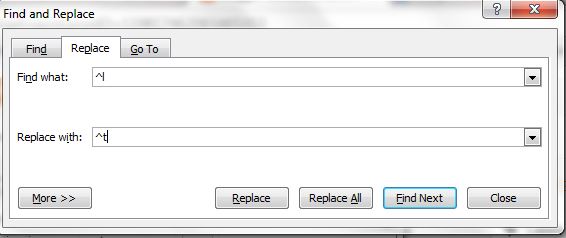
Select all text (Ctrl-A) 
Convert text to table

Translating text into hebrew

Paste the words from Enchanted Learning into  translate.google.com

Select the translated hebrew text and paste it in a new word document


You will need to edit the text to make sure that all the words were translated correctly.

Prepare the hebrew text to be merged with the pictures
                                                  : Find: ^l^l  Replace with ^p


                                                   Find: ^p^l Replace with ^p


                                                   Find ^l Replace with " * "


Put in Nekudos 

Go to http://www.nakdan.com/Nakdan.aspx (you  will need to buy the program after a trial use)


Select approximately 10 lines from the hebrew document. 
Paste into the  area on the right.
If there is a word that has the wrong nekudos, click on the word. Additional options to choose will appear.
Click נקד הכול.
Copy all the Text with nekudos
Paste it back into the word document and select another 10 lines of text 
Keep adding nekudos until you have completed the whole document.

Get the hebrew text ready to be combine with English

Select All - Ctrl-A
Convert Text to Table (use * as the divider)

Select the two columns of text and copy

Combine hebrew, english, and pictures

Click on  the table with the english words

On the Layout Tab, select Properties

Change the table to right-to-left


Insert two columns to the left of the pictures
Select the columns
Paste your words


You can now use your new dictionary.
You can sort it, or put it in davka writer to do further editing.

It sounds complicated, but once you get the hang of it - it's a breeze.

Sunday, February 20, 2011

Teaching Beginning Chumash - the ITL system

I spent some time teaching students who insisted they couldn't translate a pasuk. I tried to create a systematic way of reaching them. Here are my ideas

Rationale for system - The best learning comes through authentic involvement in the process. The process is modeled after being an apprentice rather than a student. An apprentice is involved to the best of his ability, while a student is perceived as an empty vessel to be filled by the teacher. To be authentically involved, the student must be provided with scaffolds so that they can act like the experts and can learn gradually how to be an expert.

Translated from jargon to English - I need to learn with my students not teach at my students.

For chumash, the key component missing is knowledge of grammatical structure and common words.


check out this post for reflections on using the ITL system
video examples of ITL independent Torah Learning -

Step 1.
  1. Teach taamei hamikra - very essential - you need to stop after these signs to be able to translate pesukim. This step must be first!
  2. Pick a logical chunk of story. Up to 10 pesukim works nicely. Pick out most common shorashim, prefixes, suffixes. Write all of them down. Translate the words using the shorashim and prefix list guide sheets.
  3. Go through the pesukim and put lines after the words with the trop signs
  4. Take turns reading the pesukim consulting the list of prepared words for help. I help break down the words initially by saying them syllable by syllable. Make sure that the reader stops by the trop signs.
  5. Summarize the content of each of the pesukim.
  6. Go through pasuk by pasuk and learn in depth (sometimes I combine steps e &f )
  7. Read rashi for the knowledge of the letters rather than translation. If rashi skills are very weak start with rashi workbook, rashi matching games, etc.
Step 2
No putting in trop signs first, don't help syllable by syllable, don't summarize pesukim rather make sure that phrases are understood
  1. Pick a chunk, go through and pick out most common shorashim, prefixes, suffixes. Write all of them down. Translate using guide sheets.
  2. Take turns reading the pesukim consulting the list of prepared words for help. Make sure that the trop signs are followed religiously
  3. Ask the students to find the phrase that means xyz or to answer an ?? ?? ????
  4. Go through pasuk by pasuk and learn in depth (sometimes I combine steps j &k) making sure that the student can ask good questions
  5. Read rashi for the knowledge of the letters rather than translation
Step 3
  1. Prefixes and suffixes are learned with their context - the Shorashim.
    1. Pick a chunk, go through and pick out words that have prefixes and suffixes. Write down the ones you don't know. Pick out shorashim & write down the ones you don't know. Translate those words before reading the pesukim
    2. Concentrate on finding ?' ?????? and translating correctly.
    3. Take turns reading the pesukim consulting the list of prepared words for help. Make sure that the trop signs are followed religiously
    4. Ask students to make up their own "Who is it talking about"
    5. Go through pasuk by pasuk and learn in depth (mostly I combine steps j &k)
    6. Start to work on rashi skills - have students rewrite rashi by writing out phrases, underline question, answer, key words, quotes, begin rashi vocab journal)
Step 4
Almost there!
      1. Pick a chunk, orally review difficult words, prefixes
      2. Take turns reading the pesukim. Make sure that the trop signs are followed religiously
      3. Go through pasuk by pasuk and learn in depth. begin reading meforshim with nikud.
Here is a sample of some of my classwork http://hochheimer.net/shira_classes/sample%20remedial%20work.pdf
test